
Key findings
- 1SPAM contains only 6 ingredients but each is either industrially processed or a chemical additive
- 2Sodium nitrite serves a dual function: preventing botulism and maintaining the pink color consumers expect
- 3The retort canning process (250 degrees F under pressure) gives SPAM a 5-year shelf life but fundamentally alters the meat proteins
What goes into SPAM products?
SPAM was designed in 1937 as a shelf-stable protein source, and its formulation reflects early 20th-century food engineering. The product combines pork shoulder and ham, then relies on sodium nitrite for both preservation and the characteristic pink color. Without nitrite, canned meat turns an unappetizing gray. Modified potato starch absorbs moisture released during retort processing (the high-pressure canning step at 250 degrees F), preventing the gelatinous liquid that forms in simpler canned meats. A notable detail: SPAM's 6 listed ingredients understate its complexity because "pork with ham" is itself a processed input, and the retort canning process at extreme temperatures fundamentally alters the protein structure.
How 27 spam products break down
Share of products at each processing level, in our analysis.
SPAM brand comparison
From least to most processed in our database.
How to read a SPAM label
- 1
Sodium nitrite is the key ultra-processing marker, and it is a chemical preservative and color fixative
- 2
Modified potato starch is an industrially altered starch not found in home kitchens
- 3
"Mechanically separated chicken" indicates paste-like meat recovered under high pressure
- 4
SPAM Lite and other variants add additional ingredients including sodium ascorbate and smoke flavoring
Ketzal for iPhone
Got SPAM At Home?
Scan yours in Ketzal to see how your exact product scores, not just the average, plus a less processed swap.
Scan It Free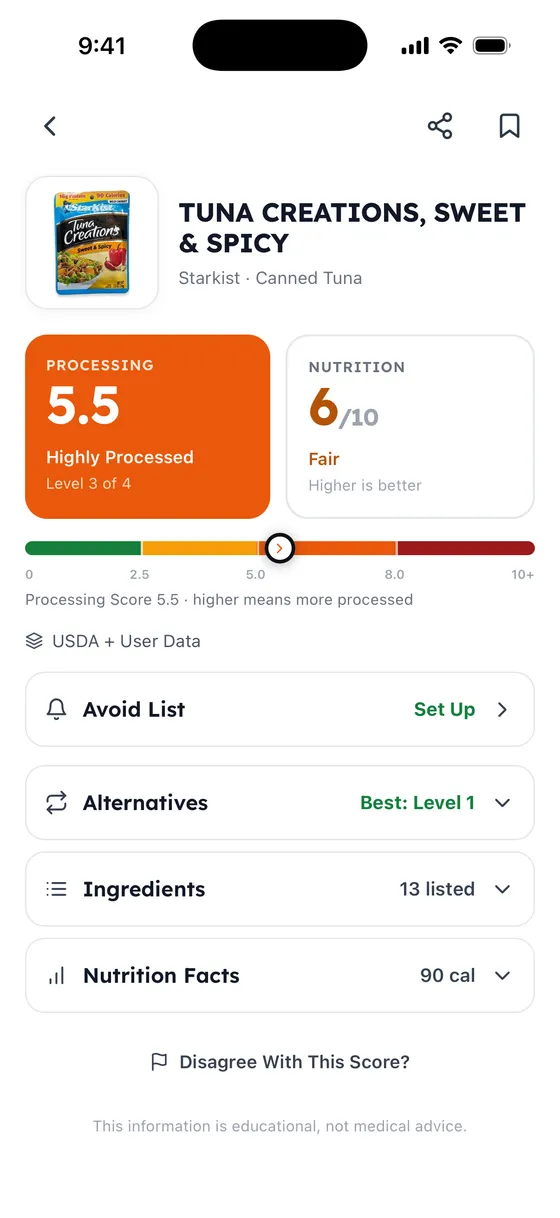
Frequently asked questions
What is SPAM actually made of?
SPAM Classic is made from pork shoulder and ham, salt, water, modified potato starch, sugar, and sodium nitrite; some varieties also list mechanically separated chicken, so check the can. Despite urban myths, it does not contain mystery meat; the ingredients are clearly listed.
Is SPAM worse than deli meat?
Of the 27 SPAM products we score, 4 are Level 4 (ultra-processed) and 22 are Level 3. Search deli meat to see its products' own scores. SPAM has fewer ingredients than typical deli turkey but includes modified potato starch, which most deli meats do not.
Why does SPAM last so long?
The combination of sodium nitrite (chemical preservative), salt (osmotic preservation), and retort canning (high-pressure sterilization at 250 degrees F) creates a shelf life of 3-5 years. Each method addresses a different spoilage pathway.
Is there a less processed alternative to SPAM?
Canned pork or chicken with just meat, water, and salt is far less processed. Look for products without sodium nitrite or modified starches. Home-canned meats are also significantly less processed.