
Key findings
- 1In our analysis, sugar-free versions of products typically have higher processing scores than their regular counterparts; removing sugar adds ingredient complexity
- 2The least processed sugar-free options use single-source natural sweeteners like stevia leaf extract or monk fruit extract with minimal additional additives
- 3Whole fruits and naturally sweet foods (dates, bananas, sweet potatoes) provide sweetness with no sweetener additives needed
Why is Sugar Free Foods ultra-processed on average?
The "sugar-free" designation addresses only one dimension of food processing. To replicate the sweetness, bulk, browning, and preservation properties of sugar, manufacturers typically add multiple replacement ingredients. Artificial sweeteners like sucralose (produced through selective chlorination of sucrose) and acesulfame potassium (a synthetic compound) provide sweetness at much lower concentrations. Sugar alcohols like erythritol (produced through yeast fermentation of glucose) and sorbitol (produced through catalytic hydrogenation of glucose) provide both sweetness and bulk. Additional thickeners, stabilizers, and flavor enhancers are often needed to compensate for the functional properties that sugar provided. The result is often a product with more total ingredients and more industrial processing steps than the sugar-containing version. In our analysis, sugar-free products average a Processing Score of 10.1, which is Level 4.
How 1,857 sugar free foods products break down
Share of products at each processing level, in our analysis.
Sugar Free Foods brand comparison
From least to most processed in our database.
How to read a sugar free foods label
- 1
Sugar-free does not mean less processed; compare the total ingredient count of sugar-free vs regular versions of the same product
- 2
Look for which sweetener system is used: sugar alcohols (erythritol, xylitol) are generally simpler than artificial sweeteners (sucralose, aspartame, acesulfame K)
- 3
Maltodextrin and polydextrose are common bulking agents in sugar-free products, and both are industrially produced starch derivatives
- 4
Some products combine multiple sweetener types (e.g., stevia + erythritol + monk fruit) for a more balanced flavor profile
Ketzal for iPhone
Got Sugar Free Foods At Home?
Scan yours in Ketzal to see how your exact product scores, not just the average, plus a less processed swap.
Scan It Free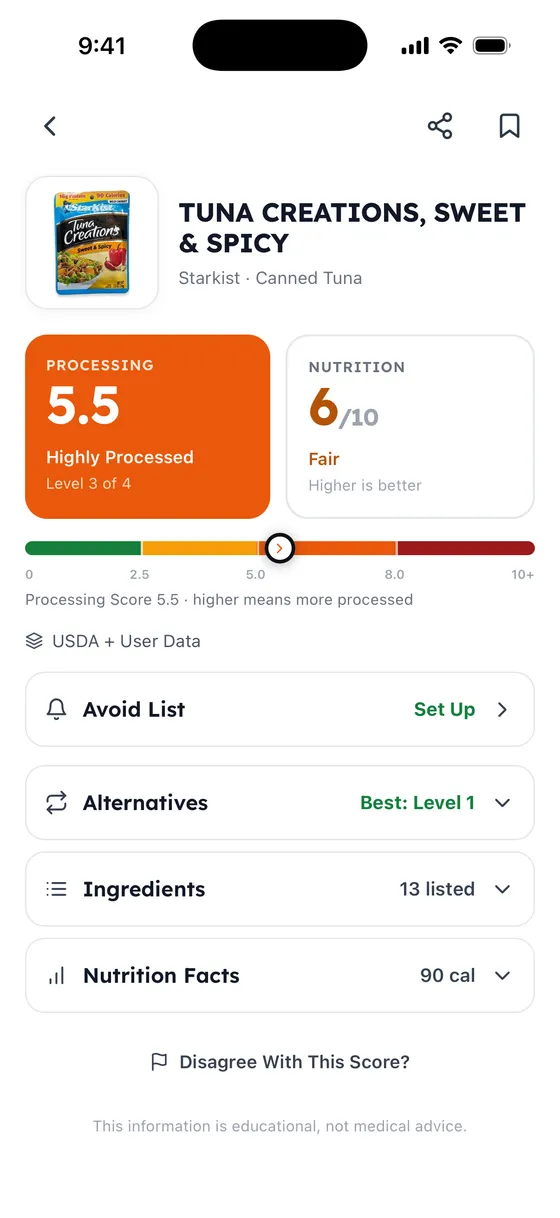
Frequently asked questions
Are sugar-free foods ultra-processed?
Many sugar-free foods carry the markers our Processing Score counts. Removing sugar typically requires adding artificial sweeteners, sugar alcohols, bulking agents, and additional stabilizers, which increases the total number of industrial ingredients compared to the regular version. In our analysis, sugar-free products average a Processing Score of 10.1, which is Level 4.
What sweeteners are used in sugar-free foods?
Common sweeteners in sugar-free products include artificial sweeteners (sucralose, aspartame, acesulfame potassium), sugar alcohols (erythritol, sorbitol, xylitol, maltitol), and natural sweeteners (stevia, monk fruit extract). Many products combine multiple sweetener types.
Is sugar-free healthier than regular?
From a processing perspective, sugar-free versions often score higher (more processed) than regular versions of the same product. The trade-off between reduced sugar and increased industrial additives depends on individual dietary needs. Our analysis focuses on processing level, not dietary recommendations.