
Most Processed Breads
Each product is ranked by its own Processing Score, highest first. To keep the list from being one company's catalog, it shows at most two products from any one brand.
Bread by the Numbers
We scored every bread product in our database: 9,053 items across 931 brands. In our analysis, about 86% land in the Highly or Ultra-Processed tiers.
What should you look for on the label?
- Real bread needs only flour, water, salt, and yeast. Reject any loaf with 10+ ingredients
- Watch for DATEM, azodicarbonamide, and calcium propionate. All three signal industrial production
- "Whole wheat" does not mean less processed. Check the full ingredient list
- Look for "slow fermented" or "sourdough" which indicate traditional methods
Least Processed Breads
For context, here are the top 5 of the opposite ranking, the least processed breads in our analysis.
Ketzal for iPhone
Find The Swap For What You Already Buy.
Scan a product you use and Ketzal suggests less processed options from the same category.
Find My Swap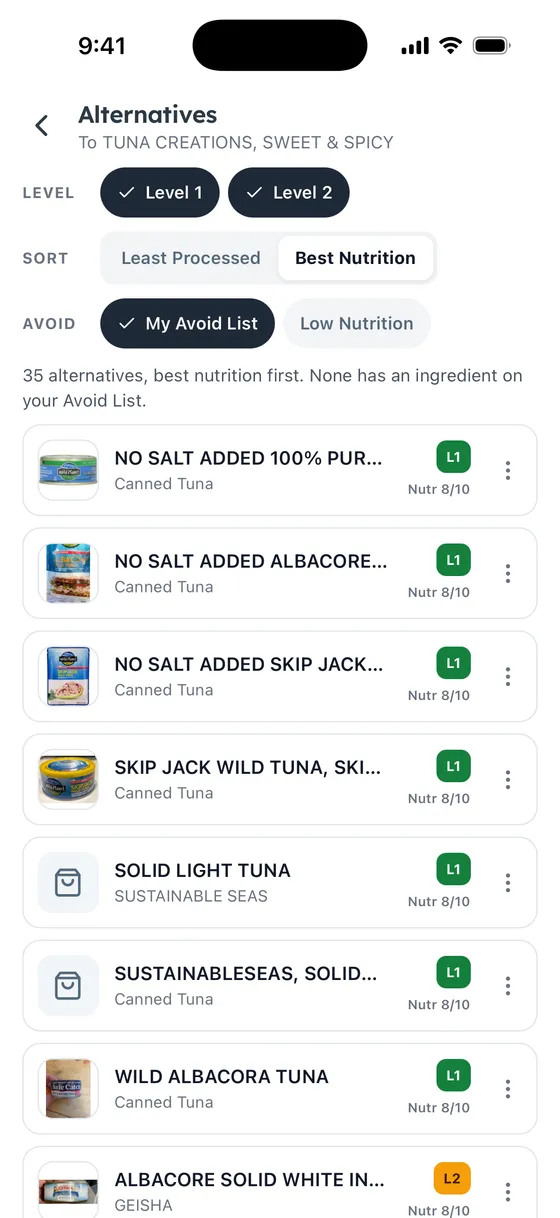
How are products scored?
Every product is evaluated using two independent scores. The Processing Score (lower is better) measures the degree of industrial processing based on ingredient analysis, including the presence of artificial additives, preservatives, and highly modified ingredients. The Nutrition Score (higher is better) rates overall nutritional quality, rewarding protein and fiber while penalizing excess sodium, added sugars, and saturated fat.
Products are assigned to one of four processing levels: Minimal (score ≤ 2.5), Processed (2.6 to 5.0), Highly Processed (5.1 to 8.0), and Ultra-Processed (above 8.0). Each product in the ranking is placed by its own Processing Score, not by its brand. Based on our analysis of 445K+ curated products from the USDA FoodData Central database. For a deeper look, see our Processing Score guide and Two-Score System explanation.
Frequently Asked Questions
Why are some bread brands so highly processed?
Mass-market bread brands prioritize shelf life and soft texture through chemical dough conditioners, preservatives, and sweeteners. The Chorleywood process (1961) enabled this industrial approach.
Are enriched breads ultra-processed?
Enrichment (adding vitamins) alone is not ultra-processing. However, enriched breads almost always contain additional industrial additives that push them toward the high end of our scale.
Is white bread always more processed than whole wheat?
Not necessarily. Some white artisan breads (flour, water, salt, yeast) score lower than commercial whole wheat breads packed with additives and sweeteners.