
Least Processed Baby Food
Each product is ranked by its own Processing Score, lowest first. To keep the list from being one company's catalog, it shows at most two products from any one brand.
Baby Food by the Numbers
We scored every baby food product in our database: 266 items across 27 brands. In our analysis, about 39% land in the Highly or Ultra-Processed tiers.
What should you look for on the label?
- Purees should list only the fruit or vegetable and water
- Citric acid and ascorbic acid are preservatives, common but not necessary in fresh purees
- Added starches (rice starch, corn starch) are thickeners that increase processing
- Toddler snacks (puffs, melts) are significantly more processed than purees
- Organic baby food skips synthetic pesticides but can still contain organic starches and acids
Most Processed Baby Food
For context, here are the top 5 of the opposite ranking, the most processed baby food in our analysis.
Ketzal for iPhone
Find The Swap For What You Already Buy.
Scan a product you use and Ketzal suggests less processed options from the same category.
Find My Swap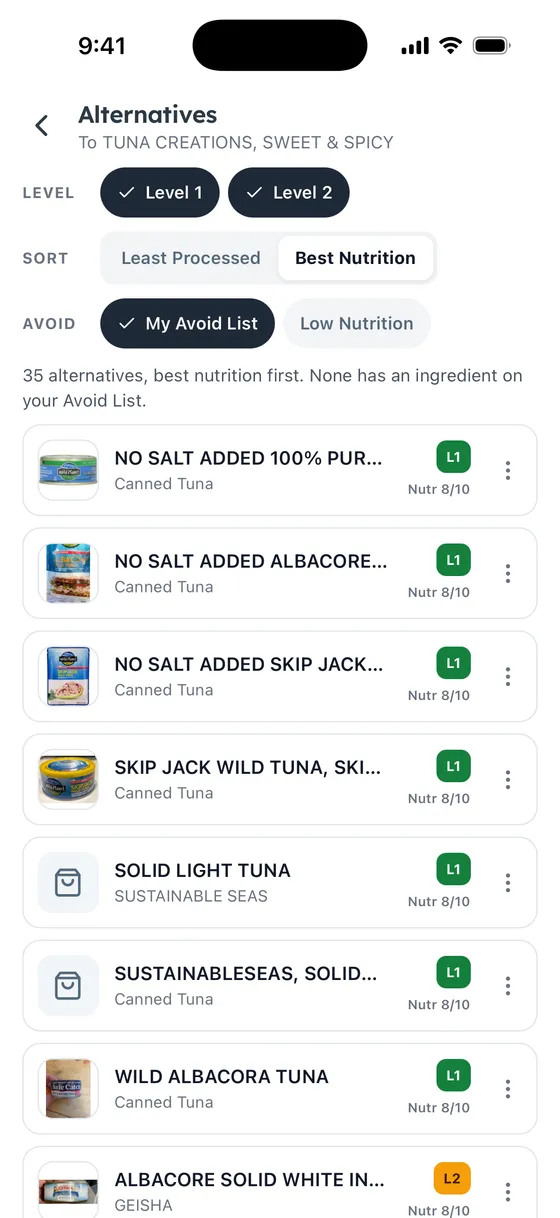
How are products scored?
Every product is evaluated using two independent scores. The Processing Score (lower is better) measures the degree of industrial processing based on ingredient analysis, including the presence of artificial additives, preservatives, and highly modified ingredients. The Nutrition Score (higher is better) rates overall nutritional quality, rewarding protein and fiber while penalizing excess sodium, added sugars, and saturated fat.
Products are assigned to one of four processing levels: Minimal (score ≤ 2.5), Processed (2.6 to 5.0), Highly Processed (5.1 to 8.0), and Ultra-Processed (above 8.0). Each product in the ranking is placed by its own Processing Score, not by its brand. Based on our analysis of 445K+ curated products from the USDA FoodData Central database. For a deeper look, see our Processing Score guide and Two-Score System explanation.
Frequently Asked Questions
What is the best baby food?
In our analysis, the best baby foods are those with the simplest ingredient lists. Single-ingredient purees (fruit + water) score lowest. The products ranked here have the lowest processing scores in the category.
Are baby food pouches processed?
Baby food pouches range from single fruit purees, at the bottom of our scale, to multi-ingredient blends with added starches and concentrates, which score higher. Single-ingredient pouches are comparable to jar purees. Multi-ingredient pouches with grains and protein concentrates score higher.
Is homemade baby food better than store-bought?
Homemade baby food gives you complete control over ingredients, so a single-ingredient puree made at home scores at the bottom of our scale. It is nutritionally equivalent to simple store-bought purees but avoids added starches, citric acid, and other commercial additives. A basic food processor and ice cube trays are all you need.
Is organic baby food less processed?
Organic baby food skips synthetic pesticides but can still contain organic citric acid, organic corn starch, and organic ascorbic acid. The organic label addresses farming practices, not processing level. Always check the full ingredient list.