
All nutrient values are per 100g or 100ml. Source: USDA FoodData Central.
Sugar — particularly added sugar — is one of the most debated ingredients in the modern food supply. The American Heart Association recommends no more than 25g (women) to 36g (men) of added sugar per day, yet the average American consumes over 70g. Ultra-processed foods are the primary source.
We analyzed 1.84 million food products with sugar data from the USDA FoodData Central database. While "sugar-free" processed alternatives exist, many achieve zero sugar through artificial sweeteners and extensive processing. The lowest-sugar whole foods need no such trade-offs.
Top 20 Lowest Sugar Foods
Products ranked by sugar content per 100g, with processing scores.
Do high-sugar foods mean more processing?
The data reveals an important nuance: many "low sugar" and "sugar-free" products achieve their claims through industrial processing — replacing sugar with artificial sweeteners, sugar alcohols, or modified starches. These products often score Level 3-4 on processing.
Meanwhile, naturally low-sugar foods — vegetables, meats, eggs, nuts, seeds, and plain dairy — are inherently low in sugar without any reformulation. The processing score gap between natural low-sugar foods and engineered "sugar-free" alternatives is significant.
The "Best Low-Processing Picks" section highlights foods that are naturally low in sugar, not engineered to be sugar-free.
Top 5 sugar products, in detail
AdvancePierre Flame Grilled Beef Burger, 2.01 oz.
AdvancePierre Flame Grilled Beef Pattie, 4.0 oz.
AdvancePierre Flame Grilled Beef Steak Burger
AdvancePierre Flame Grilled Beef Steak Burger, 2.4 oz.
AdvancePierre Flame Grilled Beef Steak Burger, 3.0 oz.
Best low-processing sugar options
These products combine high sugar content with minimal processing (Level 1-2 only). Proof that you don't need ultra-processed products to get excellent sugar.
Sugar by food category
Average sugar content and processing scores across food categories.
How much sugar do you need daily?
The American Heart Association recommends limiting added sugars to 25g/day for women and 36g/day for men. The WHO suggests keeping total added sugars under 10% of daily calories (ideally under 5%). The Dietary Guidelines for Americans set the limit at less than 10% of total calories. Currently, the average American consumes about 17 teaspoons (71g) of added sugar daily.
- 1Focus on naturally low-sugar foods (vegetables, eggs, meats, nuts) rather than "sugar-free" processed alternatives
- 2Check ingredient lists for hidden sugars: dextrose, maltose, corn syrup solids, and 50+ other names for sugar
- 3"No sugar added" doesn't mean sugar-free — fruit juices and dried fruits are naturally very high in sugar
- 4Plain yogurt (4-5g sugar per 100g) vs. flavored yogurt (12-15g per 100g) is one of the starkest processing-sugar trade-offs
Ketzal for iPhone
Check What's Already In Your Kitchen.
Scan a barcode, on the shelf or in your pantry, and see both scores in seconds. Free, no account needed.
Scan It Free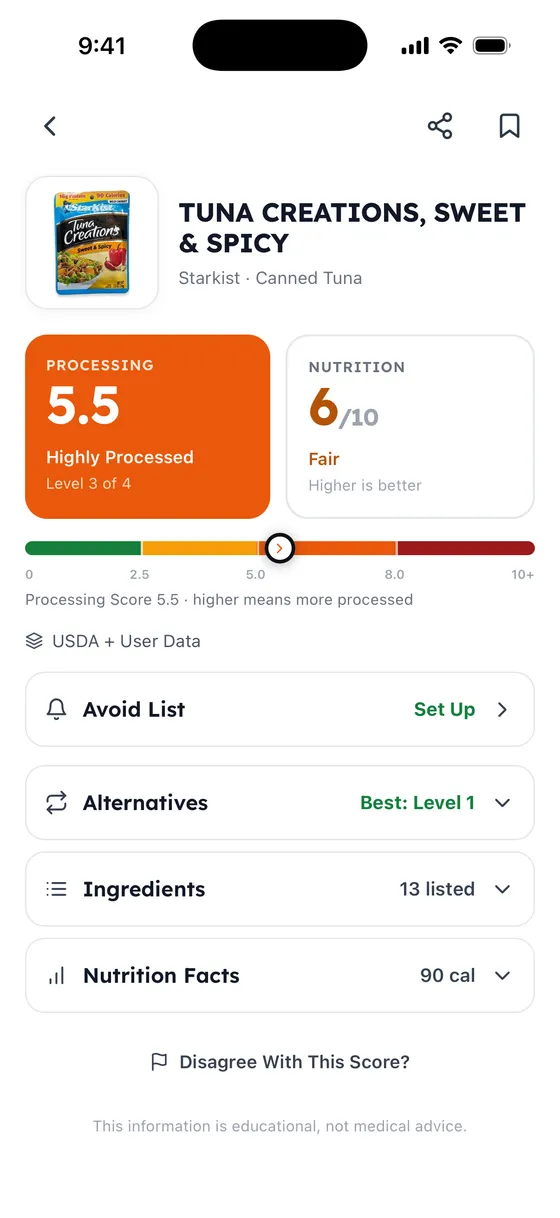
Frequently asked questions
What foods have the lowest sugar content?
Meats, fish, eggs, most vegetables, nuts, seeds, and plain fats (butter, oils) contain little to no sugar naturally. Our database shows these minimally processed foods consistently contain under 1g sugar per 100g.
Are sugar-free products healthier than regular versions?
Not necessarily. Many "sugar-free" products replace sugar with artificial sweeteners and additional processing. Our data shows sugar-free versions typically score 2-3 processing levels higher than whole food alternatives that are naturally low in sugar.
How much sugar per day is recommended?
The AHA recommends no more than 25g/day for women and 36g/day for men of added sugar. The WHO recommends under 10% of calories from added sugars (about 50g on a 2000-calorie diet), ideally under 5%.
What is the difference between total sugars and added sugars?
Total sugars includes both naturally occurring sugars (lactose in milk, fructose in fruit) and added sugars. Added sugars are those introduced during processing. A plain apple has ~10g total sugars but 0g added sugars.
Is low sugar soda better than regular soda?
Low sugar and diet sodas reduce sugar content by replacing it with artificial or non-nutritive sweeteners like aspartame, sucralose, or stevia. While they contain less sugar, they typically score Level 4 (Ultra-Processed) in our analysis due to artificial sweeteners, phosphoric acid, caramel color, and other additives. From a processing standpoint, both regular and low sugar soda rank among the most processed beverages. Water, unsweetened tea, and black coffee are Level 1 alternatives with zero sugar.