
Least Processed Peanut Butter
Each product is ranked by its own Processing Score, lowest first. To keep the list from being one company's catalog, it shows at most two products from any one brand.
Peanut Butter by the Numbers
We scored every peanut butter product in our database: 2,770 items across 412 brands. In our analysis, about 20% land in the Highly or Ultra-Processed tiers.
What should you look for on the label?
- The best peanut butter lists only "peanuts" or "peanuts, salt"
- Hydrogenated or partially hydrogenated oils prevent separation but add trans fats
- Added sugar and molasses are unnecessary in quality peanut butter
- If it does not need refrigeration after opening and does not separate, it contains stabilizers
Most Processed Peanut Butter
For context, here are the top 5 of the opposite ranking, the most processed peanut butter in our analysis.
Ketzal for iPhone
Find The Swap For What You Already Buy.
Scan a product you use and Ketzal suggests less processed options from the same category.
Find My Swap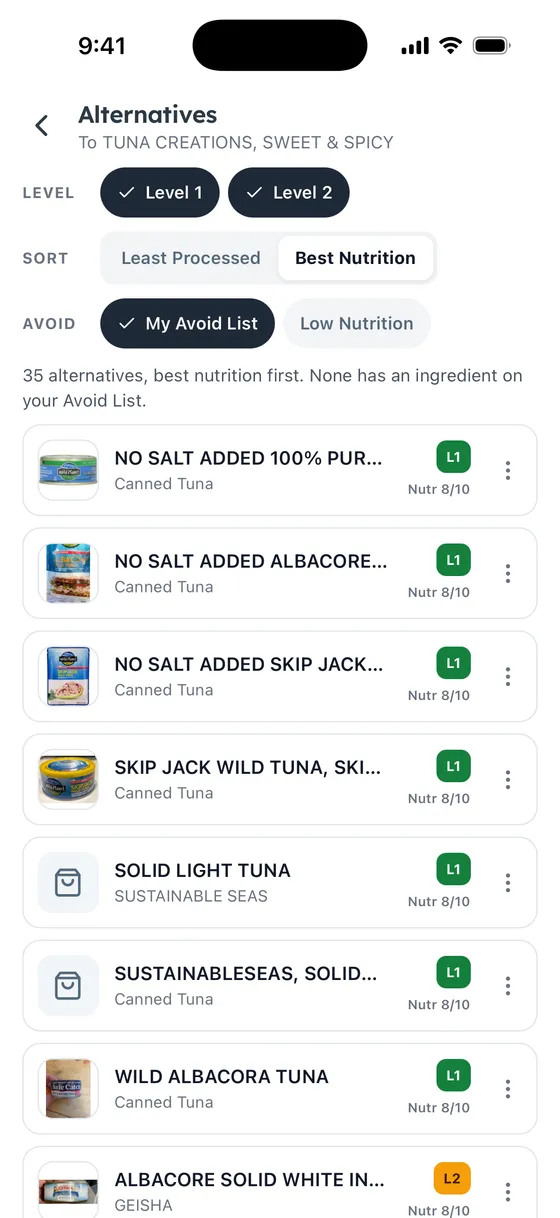
How are products scored?
Every product is evaluated using two independent scores. The Processing Score (lower is better) measures the degree of industrial processing based on ingredient analysis, including the presence of artificial additives, preservatives, and highly modified ingredients. The Nutrition Score (higher is better) rates overall nutritional quality, rewarding protein and fiber while penalizing excess sodium, added sugars, and saturated fat.
Products are assigned to one of four processing levels: Minimal (score ≤ 2.5), Processed (2.6 to 5.0), Highly Processed (5.1 to 8.0), and Ultra-Processed (above 8.0). Each product in the ranking is placed by its own Processing Score, not by its brand. Based on our analysis of 445K+ curated products from the USDA FoodData Central database. For a deeper look, see our Processing Score guide and Two-Score System explanation.
Frequently Asked Questions
Is peanut butter healthy?
Natural peanut butter (just peanuts, maybe salt) scores at the bottom of our scale and is a good source of peanut butter protein, delivering 7-8g per serving from whole peanuts. Commercial peanut butter with hydrogenated oils, sugar, and emulsifiers scores higher. The difference is visible: natural PB separates, processed PB stays uniform.
Why does natural peanut butter separate?
Peanuts naturally release oil. Industrial peanut butter adds hydrogenated vegetable oils to prevent this separation, creating the uniform spreadable texture consumers expect. That separation is a sign you are getting a minimally processed product.
How much protein is in peanut butter?
Peanut butter protein content is typically 7-8g per 2-tablespoon serving regardless of brand. The protein comes from the peanuts themselves, so natural peanut butter and processed versions deliver similar amounts. The difference is what else comes with that protein: just peanuts, or peanuts plus hydrogenated oils and sugar.
Is almond butter less processed than peanut butter?
Not inherently. Natural almond butter (just almonds) and natural peanut butter (just peanuts) score the same, at the bottom of our scale.