
Key findings
- 1The gap between artisanal and mass-market jerky is one of the largest in any single food category, from a few recognizable ingredients to long industrial marinades
- 2Slim Jims are not beef jerky, and they are mechanically separated chicken formed into sticks with corn syrup and soy protein
- 3Jerky made at home or from brands with short ingredient lists preserves the simplicity of the oldest meat preservation method
Why is Beef Jerky Level 3 on average?
Jerky is one of humanity's oldest preservation methods: slice meat thin, salt it, dry it. Traditional jerky requires only meat, salt, and time. Modern commercial jerky adds a long list of industrial ingredients: soy sauce (which contains hydrolyzed proteins), sugar or brown sugar, maltodextrin, sodium nitrite (color preservation), sodium erythorbate (curing accelerant), "smoke flavoring" (instead of actual smoking), and sometimes MSG or its derivatives. The distinction between brands matters enormously. Some brands keep to recognizable ingredients and whole muscle cuts, while many mass-market brands rely on long marinade ingredient lists. Slim Jims occupy a different category entirely; they are made from mechanically separated chicken, corn syrup, and soy protein, formed into a stick shape. They share a shelf with jerky but are a fundamentally different product. In our analysis, beef jerky products average a Processing Score of 6.1, which is Level 3.
How 1,569 beef jerky products break down
Share of products at each processing level, in our analysis.
Beef Jerky brand comparison
From least to most processed in our database.
How to read a beef jerky label
- 1
True jerky should start with a whole meat cut (beef, bison, turkey), reject products listing "mechanically separated" meat
- 2
Short ingredient lists (meat, salt, spices, vinegar) indicate traditional preparation
- 3
Maltodextrin, sodium nitrite, and "smoke flavoring" are the key indicators of industrial jerky production
- 4
Sugar content varies wildly: some brands add 5-8g per serving, rivaling candy in sugar density per ounce
Ketzal for iPhone
Got Beef Jerky At Home?
Scan yours in Ketzal to see how your exact product scores, not just the average, plus a less processed swap.
Scan It Free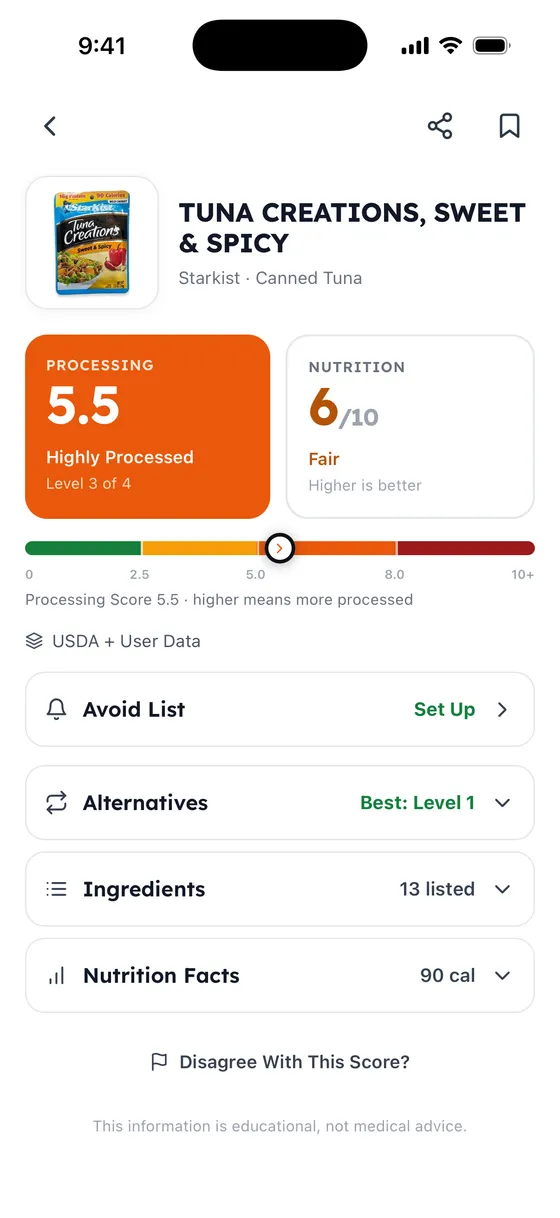
Frequently asked questions
Are Slim Jims ultra-processed?
Slim Jims are made from mechanically separated chicken, corn syrup, soy protein, sodium nitrite, and other additives, a far longer list than traditional jerky. They are not technically jerky (dried whole muscle meat) but rather a processed meat stick. Search Slim Jim to see its own average.
Is Jack Link's beef jerky ultra-processed?
Jack Link's Original lists beef, sugar, soy sauce, maltodextrin, smoke flavoring, sodium nitrite, and sodium erythorbate among a long ingredient list. The whole muscle cut keeps it closer to jerky than to a meat stick, but the additive list is extensive. Check the specific bag.
What is the least processed beef jerky brand?
Look for brands with short ingredient lists and whole muscle cuts. Homemade jerky (meat, salt, spices, dehydrated) is the least processed option. Check labels: a short list of recognizable ingredients is a good benchmark.
Is beef jerky a healthy snack?
Jerky provides high protein with no refrigeration needed. The processing concern is not the drying (an ancient method) but the industrial additives in commercial versions. Choose brands with short ingredient lists and watch sodium content; even simple jerky is high in salt by nature of the preservation process.