
Key findings
- 1Homemade smoothies from whole fruit, yogurt, and ice are far less processed than bottled ones; blending is purely mechanical
- 2In our analysis, store-bought smoothies average a Processing Score of 5.8, which is Level 3
- 3Bottled smoothies with protein isolates or artificial sweeteners tend to be more processed than those built on fruit puree
- 4Natural separation (layering) in a smoothie is actually a sign of minimal processing; industrial products are engineered not to separate
Why is Smoothies Level 3 on average?
Blending is a mechanical process that changes only the physical structure of food, not its chemical composition. A blender breaks cell walls and releases sugars, but adds nothing. The processing distinction arises when commercial manufacturers need shelf stability: pasteurization kills beneficial bacteria, juice concentrates replace whole fruit, and stabilizers like gellan gum and pectin prevent the natural separation that occurs when real fruit is blended. If the label lists "fruit puree concentrate" instead of whole fruit, the manufacturer evaporated and reconstituted the fruit: an industrial step that strips volatile flavor compounds. In our analysis, store-bought smoothies average a Processing Score of 5.8, which is Level 3.
How 736 smoothies products break down
Share of products at each processing level, in our analysis.
Smoothies brand comparison
From least to most processed in our database.
How to read a smoothies label
- 1
Whole fruit or fruit puree as the first ingredient indicates a simpler product than "juice concentrate"
- 2
Xanthan gum, gellan gum, and pectin are stabilizers that prevent natural separation, a sign of extended shelf life engineering
- 3
Protein powder isolates (whey isolate, pea protein isolate) are industrially extracted and make the product more processed
- 4
"No added sugar" does not mean less processed; juice concentrates are effectively sugar without the fiber
Ketzal for iPhone
Got Smoothies At Home?
Scan yours in Ketzal to see how your exact product scores, not just the average, plus a less processed swap.
Scan It Free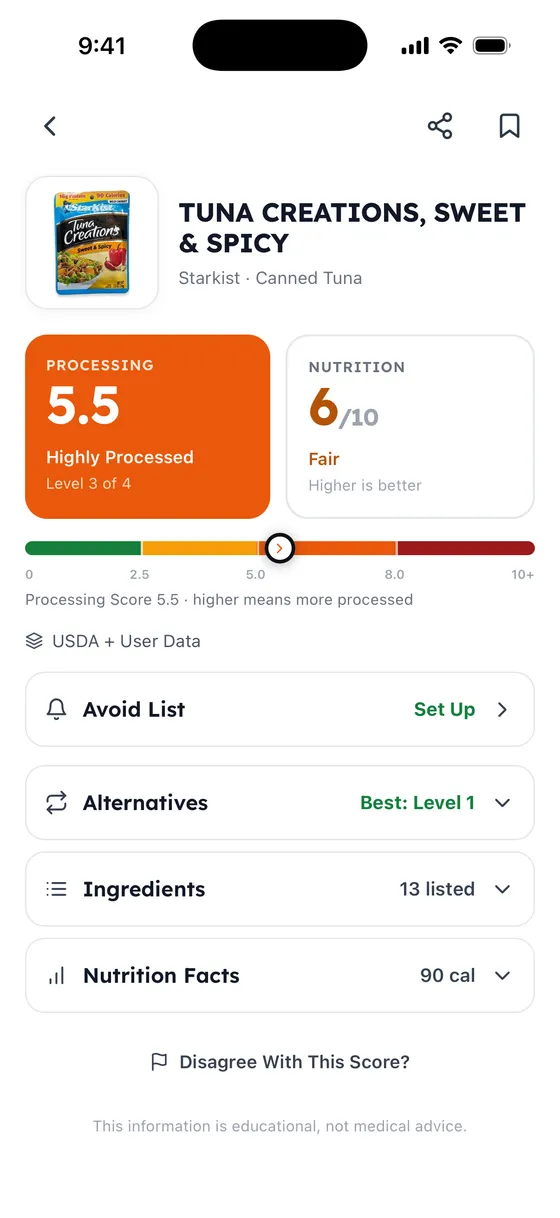
Frequently asked questions
Are store-bought smoothies healthy?
Store-bought smoothies vary widely. Brands using whole fruit puree with no added sugars are the simplest. However, many commercial smoothies list juice concentrates as the primary ingredient, contain as much sugar as soda per serving, and add stabilizers for shelf life. Check the ingredient list rather than the front label.
Is blending fruit the same as juicing?
No. Blending retains all the fiber from whole fruit, while juicing extracts only the liquid and discards the pulp. A blended smoothie from whole fruit is just the fruit, while commercial juice is more processed due to pasteurization and possible flavor pack re-addition.
Are smoothie delivery kits ultra-processed?
Frozen smoothie kits with pre-portioned whole fruit and vegetables are just frozen produce. Kits that include protein powder packets, sweetener sachets, or "superfood blends" with added ingredients are more processed.