
Key findings
- 1Traditional eggnog requires just 5 ingredients: milk, cream, eggs, sugar, and nutmeg and no stabilizers needed
- 2Commercial eggnog relies on carrageenan, guar gum, and emulsifiers to survive weeks of shelf life without separating
- 3Some brands use corn syrup alongside or instead of sugar to reduce cost and improve texture consistency
Why is Eggnog ultra-processed on average?
Homemade eggnog dates back centuries: whisk eggs and sugar, add cream and milk, spike with spirits if desired, and dust with nutmeg. It is a 5-ingredient recipe. Commercial eggnog must survive weeks of refrigerated shelf life and maintain consistent texture despite being manufactured in large batches months ahead of the holiday season. This requires carrageenan and guar gum (to maintain thickness without separation), corn syrup (cheaper than sugar and improves mouthfeel), natural flavors (to standardize the nutmeg and vanilla character batch to batch), and polysorbate 80 or mono/diglycerides (emulsifiers to keep the fat from separating). Some brands also add annatto color to achieve a consistent golden-yellow appearance regardless of egg yolk variation. In our analysis, eggnog products average a Processing Score of 8.2, which is Level 4.
How 173 eggnog products break down
Share of products at each processing level, in our analysis.
Eggnog brand comparison
From least to most processed in our database.
How to read a eggnog label
- 1
Homemade eggnog (milk, cream, eggs, sugar, nutmeg) is the simplest option, with no stabilizers
- 2
Look for brands listing milk and cream before corn syrup or sugar in the ingredient list
- 3
Carrageenan and guar gum are thickeners that commercial eggnog uses to prevent separation
- 4
Annatto or turmeric color means the yellow hue is standardized artificially rather than coming from egg yolks
Ketzal for iPhone
Got Eggnog At Home?
Scan yours in Ketzal to see how your exact product scores, not just the average, plus a less processed swap.
Scan It Free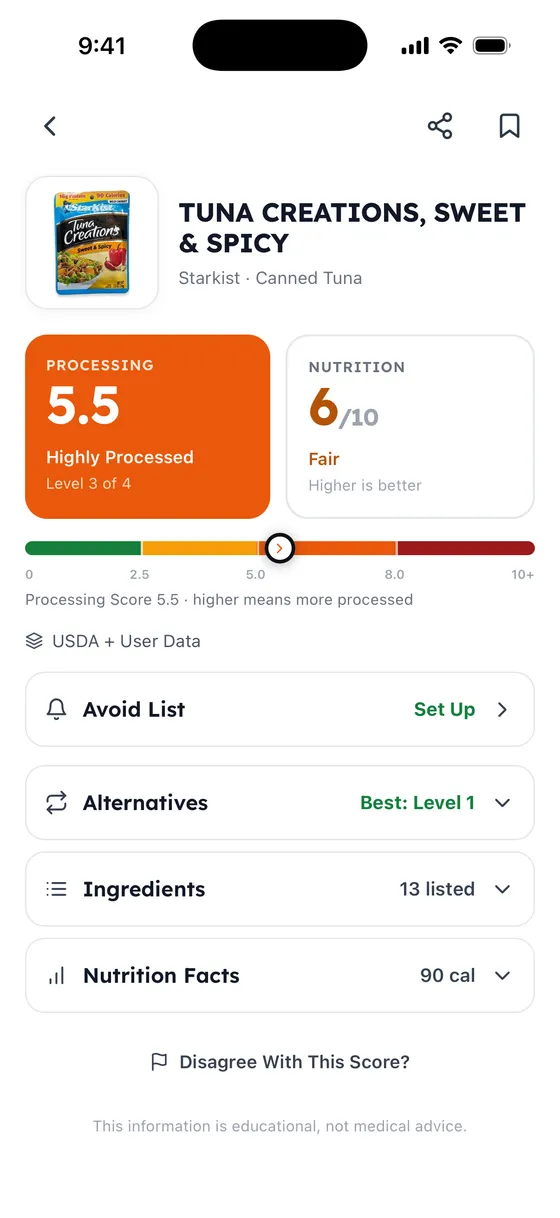
Frequently asked questions
Is store-bought eggnog ultra-processed?
In our analysis, eggnog products average a Processing Score of 8.2, which is Level 4. Store-bought eggnog contains milk, cream, sugar, eggs, and spices, but most brands add thickeners (carrageenan, guar gum), corn syrup, and natural flavors for shelf stability.
Is homemade eggnog less processed?
Yes, significantly. Homemade eggnog with milk, cream, eggs, sugar, and nutmeg is a simple mixture with no stabilizers or preservatives. It should be consumed within 2-3 days.
What about non-dairy eggnog?
Non-dairy eggnog alternatives (oat, almond, coconut-based) are typically more processed than dairy versions. They require additional emulsifiers, thickeners, and flavorings to approximate the creamy texture and flavor of dairy-based eggnog.