
Key findings
- 1Even the simplest commercial donut has a far longer ingredient list than a homemade version
- 2The "creme" filling in filled donuts is typically vegetable shortening, corn syrup, and artificial vanilla; not real custard or pastry cream
- 3A homemade donut using flour, sugar, eggs, butter, milk, yeast, and vanilla is the same concept without the industrial additives
Why is Donuts ultra-processed on average?
Donut production at industrial scale differs substantially from a home or small-bakery recipe. Traditional donuts require flour, sugar, eggs, butter, milk, yeast or baking powder, and vanilla; about 7-8 ingredients. Commercial donuts typically replace butter with palm oil or vegetable shortening (more shelf-stable), use mono- and diglycerides as emulsifiers, add sodium stearoyl lactylate as a dough conditioner, and include artificial flavors to standardize taste across production runs. The glaze adds another layer: powdered sugar, water, corn syrup, and in some brands titanium dioxide (a whitening agent). Filled donuts use "creme" made from vegetable shortening, corn syrup, modified food starch, and artificial vanilla, bearing little resemblance to actual pastry cream. In our analysis, donut products average a Processing Score of 16.1, which is Level 4.
How 947 donuts products break down
Share of products at each processing level, in our analysis.
Donuts brand comparison
From least to most processed in our database.
How to read a donuts label
- 1
Enriched bleached flour is chemically whitened wheat flour with synthetic vitamins added back, and the baseline for most commercial donuts
- 2
Palm oil or vegetable shortening replaces butter in nearly all commercial donuts for cost and shelf stability
- 3
Mono- and diglycerides are emulsifiers found in the dough; these are not present in any home donut recipe
- 4
Filled donuts use "creme" made from shortening and corn syrup, not actual pastry cream with eggs and milk
Ketzal for iPhone
Got Donuts At Home?
Scan yours in Ketzal to see how your exact product scores, not just the average, plus a less processed swap.
Scan It Free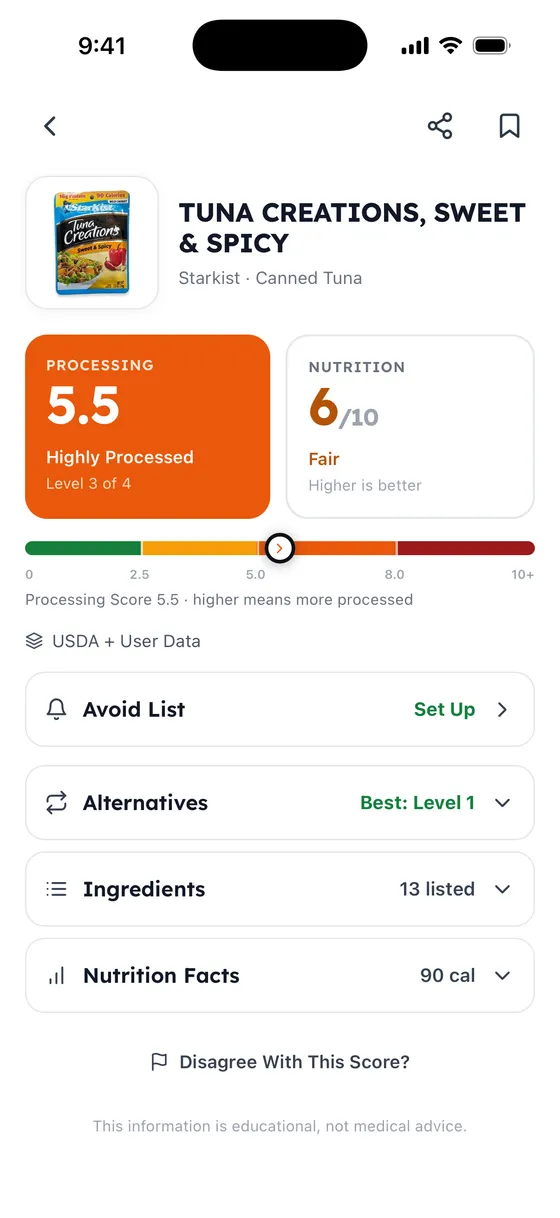
Frequently asked questions
Are Krispy Kreme donuts ultra-processed?
Commercial glazed donuts typically list palm oil, mono- and diglycerides, sodium stearoyl lactylate, and flavorings, the kinds of ingredients our Processing Score counts. In our analysis, donut products average a Processing Score of 16.1, which is Level 4. Search Krispy Kreme to see its own products' scores.
Are donuts from a bakery less processed?
Small independent bakeries that make donuts from scratch (flour, sugar, eggs, butter, yeast) produce a far less processed product. However, many bakery-style shops use pre-made mixes or frozen dough from industrial suppliers; ask if they make from scratch or from a mix.
What makes commercial donuts last longer than homemade?
Commercial donuts use emulsifiers (mono- and diglycerides), dough conditioners (sodium stearoyl lactylate), and preservatives (calcium propionate) that keep them soft and mold-free for days. A homemade donut is best eaten within hours and stales significantly by the next day; the freshness difference is the absence of these additives.